America Out of Gas – A Lesson On Patience


A man holding a flute, smiling warmly in a formal setting.

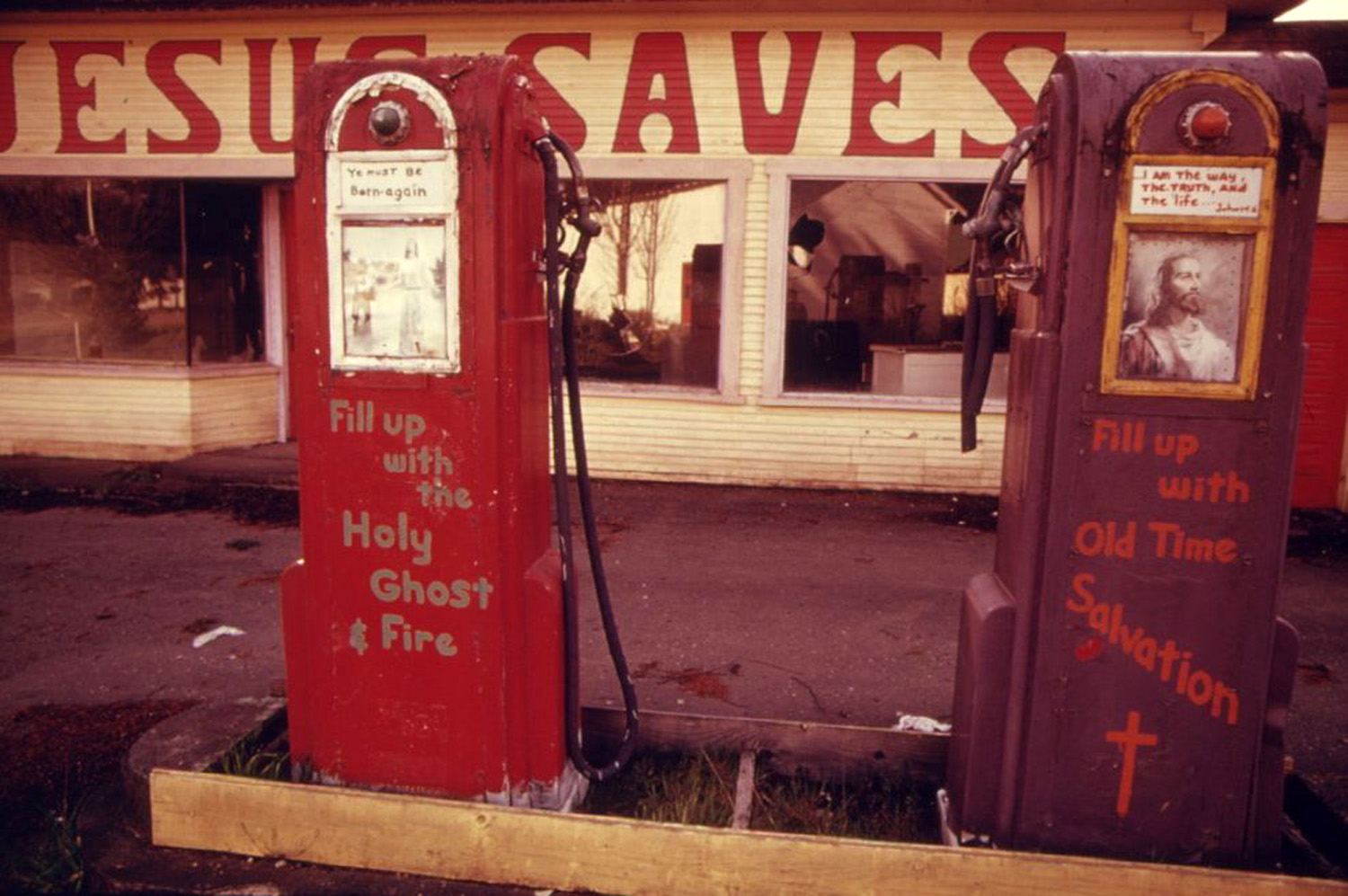
In 1973, AMERICA WAS OUT OF GAS!  This gas station in Potlach, Washington turned their gas station into a religious meeting hall. The caption might have read, “People do not live by bread gas alone, but by every word that comes from the mouth of Godâ€.

In 1973, I drove a forest green ‘68 Volkswagen Beetle. It wasn’t luxurious, nor comfortable, or have air conditioning, but I still loved my car!  It didn’t take much to fill it up either, nor was it expensive (relatively speaking). With gas prices at 25 cents to 31 cents a gallon, who cared if your car got less than 13 miles a gallon anyway.
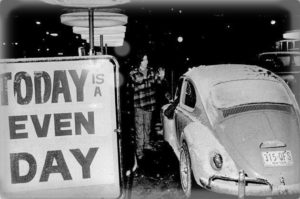
A man holding a flute, smiling warmly in a formal setting.But what good was it if you couldn’t get gas?  In October of 1973, an oil embargo crisis caused by the Organization of Arab Petroleum Exporting Countries, tested people’s patience to no end.  All oil exports to America were halted, and gas prices shot up, on average, to 38.5 cents a gallon. Odd-even rationing was mandated, meaning if the last digit of your license plate was even you could only get gas on even-numbered days.

If you had to wait at the pumps to fill up your tank, yA man holding a flute, smiling warmly in a formal setting.ou hoped that they did not run out of gas before it was your turn at the pump. Some gas stations posted flags where green meant they had gas, and red meant that they were out of gas.
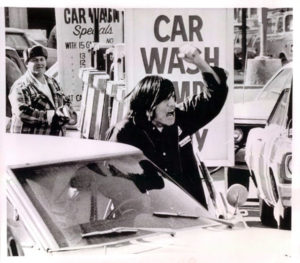
Tempers ran hot.  Fights broke out with customers who tried cutting in the line. And it was common for thieves to siphon your gas tank if they couldn’t get any at the pump.

In 1973, the mobile phone was invented, but most people would not have owned one, and would not have had the distraction of talking on the phone or texting to pass the time. So maybe you brought a good book to read. A man holding a flute, smiling warmly in a formal setting.Or if you were in college, like me, you might have used the time to study. As I was a music major in college, it was impractical for me to practice my flute in the car, so I brought my drum sticks. If you just so happened to be in line with me, you might have observed me practicing rudimentary flams, drags, and paradiddles (Right-Left-Right-Right, Left-Right-Left-Left) on the dashboard of my car. Banging on the dashboard (same cathartic effect that screaming into a pillow had) also tended to relieve my stress of having to wait in around-the-block lines with waits of 1 to 2 hours, especially when you were soooooooo on the brink of losing it. Streaking was a fad that was also quite cathartic, although I don’t recall seeing anyone do it at the gas pumps.
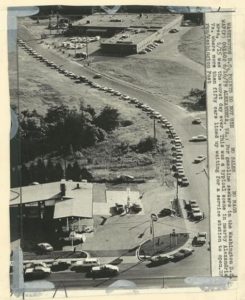
Oh, and that long trip to Vermont you were planning? Well, fuhgeddaboudit! Instead, you now worried about running out of gas and getting stranded.

So the next time you find yourself being impatient, try to get ahold of yourself and know that “The only way genuine patience can be acquired is by enduring the very trials that seem so unbearable today†(F.B. Meyer).

“Rejoice in hope; be patient in affliction; be persistent in prayer. (Romans 12:12, HCSB)

Copyright 2016 by Bill Hutzel

JOIN INSPIRATION AND HOPE ON FACEBOOK BY CLICKING HERE
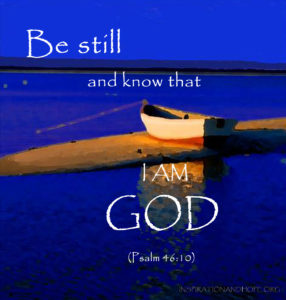
Be still and know that I am God


A man holding a flute, smiling warmly in a formal setting.

If you are observant, you would probably find that when there were significant life changing events in your life, God-incidences may likely have accompanied them. It was God’s perfect timing and means of communicating with you, and of reassuring you that everything would be okay; perhaps in just a whisper, a subtle wink from God that witnessed to your spirit.  So then, when you opened your Bible, and a verse just jumped off the page at you that spoke directly to your situation, that was not just a coincidence.

Excerpt from My Journal, July 6, 2016

Today, I randomly opened to a page in my daily devotional that spoke pointedly to me in my despair.  God had reserved it for me when I most needed to hear it — “Be still and know that I am Godâ€.

Sometimes I have difficulty sharing my personal feelings, concerns and fears, although I know that I am human and life has a way of getting us down. This is one of those times. But I share this with the hope that you will be encouraged by it when you are challenged.

A recent life event, and without getting too detailed, had brought me to a low point in my life.  Oh, sure, I am supposed to be strong and courageous, but right now, I am tempted to despair and succumb to my deepest worries and afflictions.

“O God, it still hurtsâ€.  Some days I am fine, other days I am sad.  This was one of those sad days when I just didn’t want to get out of bed.  Life just doesn’t prepare you for ……

It was now 7:45 a.m., and I had been lying awake since 6:15 a.m. I had no energy to start the day.  “Oh well, I better get up and make some coffee.  Maybe that will helpâ€.

After making my coffee, I sat down to read and pray. Today’s daily devotion from Streams in the Desert, May 10th, was timely and deeply personal. After reading it, I thought to myself, God should have personalized this one to me by prefacing it with “Dear Billâ€.

“Oh, how great the temptation is to despair at times! Our soul becomes depressed and disheartened, and our faith staggers under the severe trials and testing that come into our lives, especially during times of bereavement and suffering. We may come to the place where we say, ‘I cannot bear this any longer. I am close to despair under these circumstances God has allowed.  He tells me not to despair, but what am I supposed to do when I am at this point?’

What have you done in the past when you felt weak physically? You could not do anything. You ceased from doing. In your weakness, you leaned on the shoulder of a strong loved one …

Once you have come close to the point of despair, God’s message is not, ‘Be strong and courageous’ (Joshua 1:6), for he knows that your strength and courage have run away. Instead, he says sweetly, ‘Be still, and know that I am God’ (Psalm 46:10) …..

That is all God asks of you as his dear child.  When you become weak through the fierce fires of afflictions, do not try to be strong. Just be still, and know that [he is] God. And know that he will sustain you and bring you through the fire.

God reserves his best medicine for our times of deepest despair.â€[1]

“Be still and know that [He is] God†is sometimes all that I (we) can do to trust Him when we are suffering and weak. Then I rest in His arms and I am reminded that weeping is only for a short time, that rejoicing will come again.

FOOTNOTE

[1] Reimann, Jim; Cowman, L.B.E., Streams in the Desert: 366 Daily Devotional Readings, May 10
[2] Photograph, “Dory” by Charles Steinhacker

Copyright 2016 by Bill Hutzel

A man holding a flute, smiling warmly in a formal setting.

JOIN INSPIRATION AND HOPE ON FACEBOOK BY CLICKING HERE

God’s Love Endures

Composed by Bill Hutzel and John D’Elia

Although today’s society sends mixed messages regarding the meaning of love, there is a universally accepted goal for perfect love, and that is, Love is unconditional.  God’s love is an enduring love that is demonstrated even when we are unfaithful, unpredictable, unbelieving, and rebellious.

“Love Endures†is based on I Corinthians 13. It is often referred to as the Love Chapter.  Human love is supernatural when the union of our spirits is joined with His.  This kind of love is only possible by the grace of God who is perfect, for I am imperfect.

PRAYER:

Lord,
I don’t want to serve You with a distant heart. I want to love like You do.
Give me the kind of love that sees beyond appearances — a love that aches with compassion for those who are suffering, a heart with genuine care.
Soften me, Lord. Break down every wall of indifference or judgment that keeps me from feeling what You feel.
Anoint me with love and compassion that flows from Your Spirit — not just once, but always.
Let that be the starting place for every prayer I pray, every word I speak, and every person I serve.
Amen.

Copyright 2016 by Bill Hutzel

A man holding a flute, smiling warmly in a formal setting.
JOIN INSPIRATION AND HOPE ON FACEBOOK BY CLICKING HERE
We Cry Of / In Quiet Faithfulness

I composed “We Cry Of / In Quiet Faithfulness†in collaboration with John D’Elia, who beautifully arranged and produced the piece. His artistry helped bring the heart of the song to life, transforming a quiet prayer into a musical offering of hope and endurance.

Video produced by Bill Hutzel

Performed by
Bill Hutzel, vocals, keyboards, and flute
John D’Elia, acoustic, electric and bass guitars, and drum machine

THIS IS MY TESTIMONY IN SONG

WE CRY OF

Here today and gone tomorrow, what does life all mean? “It is the great standing perennial problem to which human reason is as far from an answer as ever.† And if life is meaningless, is not then death meaningless also?

And of troubled thoughts and lonely hearts “A troubled heart can be found in anyone, even the Christian. There are many reasons for one’s heart to be troubled — separation from or death of a loved one, unfaithfulness of a friend, a feeling of insecurity, a lack of understanding, personal problems, sin, etc. What is one to do when his heart becomes troubled? He must look to Jesus and the comfort He can giveâ€1.  

But “In my trouble, I cried to the Lord, and HE ANSWERED ME†(Psalm 120:1).

BRIDGE BETWEEN WE CRY OF AND IN QUIET FAITHFULNESS

Took wings and went to heaven
Got saved, came back to earth

Although we don’t literally take wings and go to heaven, get saved, and come back to earth, it is merely a figure of speech that illustrates our need to transcend our worldly life into a higher spiritual realm, where we meet Christ as our Savior and Lover.  It is one’s faith in Christ that saves us from controlling our own destiny and prepares us to live “In Quiet Faithfulness.”

IN QUIET FAITHFULNESS

In this song segment, lyrics borrowed from J. S. Bach, God has become my refuge, safe and sure, my staff and rod in trouble, need, and stress. I am content, and in patience, I endure.

In quiet faithfulness I love and serve my God
In trouble, need, and stress, He is my Staff and Rod.
In God I am content, In patience I endure
In Him my house and I find refuge safe and sure.

Interpretation:
J. S. Bach describes a life of steady, humble devotion to God. Even amid hardship, stress, or uncertainty, God provides strength (“Staff and Rod”)—a reference to Psalm 23. Here can be found peace and endurance not in external stability, but in trust in God, who serves as a secure and unwavering refuge for them and their household.

Foes envy, hate, indeed, from those are never far
Who with their lot and God, content and happy are.
Still, there where envy’s flame with rage surpassing fumes,
It fain must come to pass that rage itself consumes.

Interpretation:
Those who are truly content and joyful in God often draw the envy and hatred of others. This is a deep observation of human nature—peace and joy can stir resentment in those who lack it. However, the lyrics also offer a spiritual truth: unchecked envy and rage are self-destructive. Hatred devours the one who harbors it.

I therefore thank my God and love and serve Him still;
What happens in this world must ever be God’s will.

Interpretation:
Despite opposition, trouble, or suffering, we are to remain thankful and devoted. There is an unwavering trust in God’s sovereignty—that everything, even what’s painful or unclear, is part of a divine plan. This line expresses a deeply rooted, quiet surrender to God’s wisdom and timing.

In quiet faithfulness I love and serve my God
In trouble, need, and stress, He is my Staff and Rod
In God I am content, In patience I endure
In Him my house and I find refuge safe and sure.
Interpretation:
This repeated stanza serves as a refrain, reinforcing the poem’s central theme: quiet faithfulness. It’s a deliberate return to the posture of trust and peace—highlighting that, no matter what happens, this is the chosen way of life.

I therefore thank my God and love and serve Him still;
What happens in this world must ever be God’s will.
I place in child-like trust my life into His care;
In God I am content, whate’er my sphere or share.

Interpretation:
This final stanza expresses a profound surrender to God’s sovereignty—not in a way that attributes evil or suffering to God’s desire, but rather in acknowledging that nothing escapes His awareness or presence. When the speaker says, “What happens in this world must ever be God’s will,†it reflects trust that even in chaos or pain, God remains sovereign, and His purposes will ultimately prevail—even if they’re hidden from our understanding. The phrase “child-like trust†evokes Jesus’ teaching about faith like that of a child: humble, trusting, and unguarded. This isn’t blind resignation, but an active, faithful placing of one’s life in God’s care. And so, regardless of one’s “sphere†(position, influence, or circumstance) or “share†(lot in life, suffering or blessing), the soul finds contentment not in what life gives, but in who God is

(Instrumental)

Copyright 2016 by Bill Hutzel

A man holding a flute, smiling warmly in a formal setting.
JOIN INSPIRATION AND HOPE ON FACEBOOK BY CLICKING HERE

I would have despaired unless I believed


A man holding a flute, smiling warmly in a formal setting.

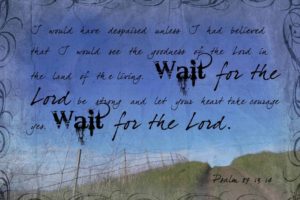
I would have despaired, unless I had believed that I would see the goodness of the Lord in the land of the living. Wait for the Lord, be strong and let your heart take courage. (Psalm 27:13-14)

The psalmist David is easy to identify with. In Psalm 27 he wrote “I really would have given up had I not believed that God is good”. Isn’t it true that most of us would despair also were it not for God who comes to our rescue? Look at the faintheartedness of David: wicked people, enemies, war, trouble, loneliness, and being forsaken, false accusations, and cruelty.  I am sure that all of us at times have experienced some of these, and probably can add a few more to the list. A focus such as David’s can also keep us from going to pieces!

Yet, how many of us actually hold on to our troubles and do not wait on the Lord? We allow our worries to stew within us, to go around and around in our heads until we feel choked and strangled by them, yet repeatedly, the Bible tells us not to despair, worry or be anxious.  You say, “Well I’m just a worrier. It is in my DNA makeupâ€. You even worry about nothing at times.

A psychologist, speaking to an audience, used an interesting analogy using a glass of water to make a point about managing stress and worry. Everyone was probably thinking “Oh no, not the half empty, half full glass analogy againâ€. But as she raised the glass, she asked, “How heavy is this glass of water?†The weight really didn’t matter. “It depends on how long you hold it”, she said.  If you hold it for an hour, the glass will appear heavier, and your arm will start to ache. If you hold on to it for a day, you will begin to feel numb and paralyzed in your arm. In each case, the weight of the glass doesn’t change, but the longer you hold on to it, the heavier it becomes. The stresses of life are kind of like the glass of water. The longer you hold on to your negative thoughts and worries, the more fainthearted we get. After a while we can even become paralyzed, and incapable of functioning.

Surmounting opposition and negativity, and not to despair, is difficult at times. I am constantly reminded to “be anxious for nothing, and to fear notâ€. Still, allowing my mind to be captive to negative thoughts causes me to go around and around again in my head, and I worry. Sometimes I am incapable of hearing God, hearing only the noise in my head that says “if this were someone else, they’d sure be worried, so you should be also. Or if I don’t make ends meet this month, I am not going to be able to pay my bills. Then what? … What if I don’t have this or that?  How could I ever be happy again?â€

But if we are to ever surmount our faintheartedness and worries, we need to discipline ourselves to earnestly seek God, and practice waiting on Him. Those are times when I must go to God and just say “I give it up to you, Father. I am helpless to know what to do. Take this situation from me and make it yoursâ€. “Turn your burdens over to the LORD, and he will take care of you (Psalm 55:22, GOD’S WORD translation).

“Once we have made up our minds that God’s goodness is in operation, we will have far less difficulty in coping with the events of everyday life. Since He is in control, and since He is a good God, we can relax in His care. The Prophet Isaiah said, ‘Thou wilt keep him in perfect peace whose mind is stayed on Thee, because he trusteth in Thee’ (Isa. 26:3). The way to become convinced of God’s goodness is to spend time with Him. ‘Wait on the Lord . . . and He shall strengthen thine heart.’ Get alone with God, and you’ll get over your fainting spell!†[1].

WAIT FOR THE LORD

Copyright 2016 by Bill Hutzel


FOOTNOTE

[1] Walk with the King, Daily e-Devotional, April 14