I need to remember He’s promised to help


A man holding a flute, smiling warmly in a formal setting.


Often times I get wrapped up in my own thoughts when I am weary and tired, or my prayers seem to have gone unanswered. In those times, I need to remember where to get HOPE again when things seem hopeless.

This morning I was meditating on the following verse in Jeremiah 29:12-14 that says “Then you will call to me. You will come and pray to me, and I will hear you. When you look for me, you will find me. When you wholeheartedly seek me, I will let you find me, declares the LORD. I will bring you back from captivity.â€

Hmm. Captivity?
It’s true, I too am a captive, but unlike Israel who was delivered into bondage with the fall of Jerusalem in 606 A.D., I am held captive by my own thoughts.
And the more I think about myself, the more miserable I become.

God wants us to know however that when we meditate on His Word and earnestly pray to Him and seek Him, He will lift us up, He will bring us out of captivity, He will restore joy in our hearts and give us peace, provide our needs, and restore our strength when we are weary and tired.

REMEMBER
When attention is focused on negative thoughts, it is possible to become quite discouraged, but when attention is diverted to God and His Word, discouragement flees and faith heightens. So be comforted to know that God is expecting us, and that if we knock, He will answer.  A similar verse to the one in Jeremiah is Matthew 7:7 that says “Ask, and you will receive (call to me). Search, and you will find (go and pray to me, you will seek me and find me). Knock, and the door will be opened for you (I will hearken unto you, I will let you find me).â€

GOD’S PROMISE – “For I know what I have planned for you, says the LORD. I have plans to prosper you, not to harm you. I have plans to give you a future filled with hope.” (Jeremiah 29:11)


Copyright 2016 by Bill Hutzel

He’s Always Been Faithful

If it weren’t for Christ’s resurrection, the words to “He’s Always Been Faithful” would not be our anthem; would not be our song.

John 19:30

Jesus said “It is finished.” He then bowed his head and gave up his spirit.  What is meant by this is that Jesus finished what the Father had sent him to accomplish in this world.  He knew what would happen on the cross, yet He still sacrificed His life so that we could have eternal life.  Jesus could have called down legions of angels to set him free and spare him suffering, yet He didn’t.

HE’S ALWAYS BEEN FAITHFUL
Words and Music by Sara Groves

Vocals, Jamie Hutzel
Flute, Bill Hutzel
Acoustic 12-String guitar, John D’Elia
Piano, Karen Dann Sundquist

Copyright 2016 by Bill Hutzel


For as he thinks within himself, so he is


“For as he thinks within himself, so he is.†(Proverbs 23:7)

A man holding a flute, smiling warmly in a formal setting.When I was a very small boy, I wanted to be “Davy Crockettâ€. I was so captivated by the person of Davy Crockett, that I would not only look forward to watching the Walt Disney television series about him with Fess Parker in the leading role, but I would also dress up like him and act out the role as a child.  I can also remember my Dad taking me down to our local record shop and buying me the hit single, the Ballad of Davy Crockett” “Davy, Davy Crockett, king of the wild frontier.â€

One day, my grandfather, who was a barber, asked me, “Billy, do you want me to cut your hair so that you look like Davy Crockett with a raccoon tail?â€Â  Of course, he was only kidding, but I don’t know if at the time I thought he was kidding as I was only 5 or 6 years old, and very gullible. Everyone thought, I am sure, that that was adorable, but as we mature into adults, many of us today, because of dissatisfaction with who we are, also dwell on and cast ourselves in roles that are not particularly suited to us.

The notion that we are what we eat or that which we dwell on is portrayed humorously in the following conversation between Basil, a middle class English writer, and Zorba, a Greek peasant, from the book “Zorba the Greekâ€.   The phrase you are what you eat, however, is not to be taken literally herein, but rather connotes, what the mind ingests has a bearing on one’s state of mind.

(Zorba) “Tell me what you do with the food you eat, and I’ll tell you who you are. Some turn their food into fat and manure, some into work and good humor, and others, I’m told, into God. So there must be three sorts of men. I’m not one of the worst, boss, nor yet one of the best. I’m somewhere in between the two. What I eat I turn into work and good humor. That’s not too bad, after all!’

(Basil) He looked at me wickedly and started laughing.

(Zorba) As for you, boss, he said, ‘I think you do your level best to turn what you eat into God. But you can’t quite manage it, and that torments you. The same thing’s happening to you as happened to the crow.’

(Basil) ‘What happened to the crow, Zorba?’

(Zorba) ‘Well, you see, he used to walk respectably, properly – well, like a crow. But one day he got it into his head to try and strut about like a pigeon. And from that time on the poor fellow couldn’t for the life of him recall his own way of walking. He was all mixed up, don’t you see? He just hobbled about.â€
― Nikos Kazantzakis, Zorba the Greek

How many of us are dissatisfied with who we are and our circumstances, and also try our level best to change things but can’t quite manage it?  Because discontent lurks in every person’s heart, we oftentimes try to change who we are, our God given talents, brains and physical appearance, and also our situations, and sometimes it is at grave cost.  Unfortunately, many of us who look in the mirror and wish we were someone else, end up tormented like the crow, and hobble about, all mixed up.

But don’t misunderstand me.  There is nothing wrong with aspiring to be something or wanting to change our circumstances for the better, just as long as it is a realistic possibility and ordained of God for me as a person.  Regardless of who I am and my circumstances, the Bible teaches that I should be content.  In Philippians 4:12-13, Paul learned to be content in whatever his circumstances and even with his physical infirmity for he says “I have learned the secret of being content in any and every situation, whether well fed or hungry, whether living in plenty or in want.  I can do everything through Him who gives me strength.â€Â  Note: the secret of Paul’s strength was not in himself, but in knowing that Jesus Christ was the source of his strength.  Paul was content because Jesus was his all sufficiency.

Whatever your situation, whatever your dissatisfaction with life, whether it be self-esteem, your job, your spouse, etc., ratA man holding a flute, smiling warmly in a formal setting.her than begrudge these things and wish you were someone else, choose to look in the mirror and focus on “whatever is right, whatever is true, whatever is honorable, whatever is fair, whatever is pure, whatever is acceptable, whatever is commendable, if there is anything of excellence and if there is anything praiseworthy—keep thinking about these things.†(Philippians 4:8, ISV).  The Bible teaches that we are changed by the things we behold or that which we dwell on. “We are what we believe we are” – C.S. Lewis.  Similarly, believers in Christ who behold in the mirror, or who “contemplate the Lord’s glory, are being transformed into his image with ever-increasing glory, which comes from the Lord, who is the Spirit†(2 Corinthians 3:18, NIV).

Copyright 2016 by Bill Hutzel

Amazing Grace


Produced, arranged, recorded,
and mixed by John D’Elia
Musicians:
John D’Elia, guitars, bass, percussion
Beth D’Elia, vocals
Bill Hutzel, solo flute

How profound to think that blessings often cause us to divert our attention away from God, and that troubles almost always make us look to God. Such were the troubles of John Newton who wrote “Amazing Grace”.

Newton wrote the words to “Amazing Grace” from personal experience. He grew up without any particular religious conviction, but his path in life  would be formed by a variety of twists and coincidences that were “often put into motion by his willful and wanton disregard for all that is right and holy and which led him into a life plagued with despair, dangers at sea, abuse, public floggings, destitution, depression, near drownings and miraculous escapes. During those years Newton often entered into a state of spiritual awakening. Consequently those times were short-lived, and he invariably lapsed into a more wicked and loathsome direction.

One particular harrowing experience at sea was used of the Lord to cause young Newton to seriously consider his standing before a holy God. After being at sea for several months with a load of lumber, livestock and beeswax, the ship ran into a violent storm. So severe was the gale that the otherwise seaworthy vessel was in danger of sinking. When the livestock were washed overboard, the crew tied themselves to the ship to keep from being swept into the sea.

For four weeks, because of damage to the ship, the sailors despaired of life. Most of their waking hours were spent at the pumps to lighten the ship of water she had taken on. Rations were so low the men feared starvation. When they finally reached a port in Ireland, Newton began a sincere effort to become right with God.â€[1]

John Newton, were it not for his troubles and despair, may never have come to write the song “Amazing Graceâ€.  The song “Amazing Grace†is Newton’s most famous hymn, and is the most popular spiritual song in the history of American music having been recorded more than 1000 times.

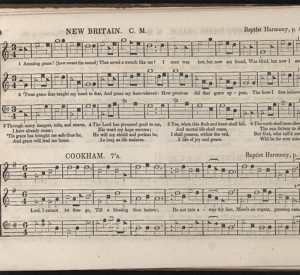
The song was first published in 1779, however, since then it has been associated with more than 20 different melodies including contemporary tunes such as from “House of the Rising Sun†by the Animals composed in the early 1960’s. The hauntingly beautiful melody that we are most familiar with today, however, was published in 1835 from an early-American tune called “New Britainâ€, although you might not recognize it right-away unless you listen closely to the parts.  The second staff below is the melody that we are familiar with.

A man holding a flute, smiling warmly in a formal setting.
An 1847 publication of Southern Harmony, showing the title “New Britain” and shape note music. (Play song)

Amazing Grace! How sweet the sound, that saved a wretch like me.

I once was lost, but now am found; was blind, but now I see.

‘Twas grace that taught my heart to fear; and grace my fears relieved.

How precious did that grace appear; the hour I first believed.

Through many dangers, toils and snares, I have already come.

‘Tis grace has brought me safe thus far and grace will lead me home.

Of the tens of thousands of times it has been performed, the instrumental style and expressive quality may change with each interpretation, but the message always remains the same; that forgiveness and redemption are possible regardless of the sins we have committed, and that our souls can be delivered from despair through God’s Amazing Grace.

When we find it difficult to spiritually concentrate on God, and although troubles almost certainly always make us look to God, remember also to look to Him when you are enjoying His blessings because blessings tend to divert our attention away from God. “Narrow all your interests until your mind, heart and body focus on Him.â€[2] “Look to me, and be saved, all the ends of the earth; for I am God, and there is no other.†(Isaiah 45:22,WEB).

Copyright 2016 by Bill Hutzel

FOOTNOTES

[1] https://www.crossway.org/tracts/the-amazing-story-behind-amazing-grace-3033/

[2] Chambers, Oswald “My Utmost for His Highestâ€, January 27

So this is what it feels like to be a castaway on a deserted island


A man holding a flute, smiling warmly in a formal setting.


A man on a deserted island placed a message for help in a bottle and threw it into the sea.  The bottle drifted on the waves for a while, until someone found it and read the man’s note.  It was an SOS for help.  A search and rescue party was then dispatched.

The island is either a perceived place of loneliness, or an actual place of banishment. Often we feel as if God has deserted us when life hurts so badly that we cannot think, plan, dream, or hope anymore. As an example, the hurt of a broken marriage and of the heartbreak can be debilitating. When abandoned by the one you love, the hurt can be too much to bear. You feel like a castaway on a deserted island. I have experienced pain nothing like this before. It saps you of all your energy. On the island you feel alone with your pain. No one is there to help you overcome your loneliness and discouragement. You grieve with tears that no human sees or hears.

Have you forgotten that God sees and hears? He has searched you and knows you. He knows when you sit down and when you rise up. He knows your every thought and is acquainted with all your ways, even to the remotest parts of the sea.

Perhaps several weeks, months or a year has passed since you wrote your message in a bottle. You cry out once again “God, rescue me! Come quickly, Lord, and help meâ€[1].

As you look up into the night time sky, you can’t help but marvel at the infinite number of stars. How vast is the sum of them!  If you should count them, they would outnumber the sand.

You’re drifting off to sleep now. You take wings and ascend into the heaven, searching for the Heart Mender, but tonight you cannot find Him, yet you know he is out there somewhere.

Upon waking, you rub your swollen eyes.
“I don’t believe what I saw,
A hundred billion bottles washed up on the shore
Seems I’m not alone in being alone
A hundred billion castaways looking for a homeâ€[2]

Agony.                              

Betrayal.

Heartbreak.

Disappointment.

Hopelessness.

Despair.

Loneliness.

Anger.

Bitterness.

Unforgiveness.

Loss of identity.

You have flares. Send one up. Maybe a passing ship will see you. You cry out “Rescue me O Lord!â€

Many of you will relate to the character played by Tom Hanks (Chuck) in the movie Castaway, although metaphorically. He is a man marooned on an island after his plane crashes into the ocean during a violent storm. After crashing into the ocean, he is able to cling to his life-raft, loses consciousness, and floats all night before being washed up on a deserted island. He is tested mentally, physically, and emotionally in order to survive.

Similarly, I too have crashed, and have been tested, and wonder why it seemed that God had abandoned me, or why I must suffer. But, in retrospect, I have come to realize that it was during those times of loneliness, pain and suffering that I grew stronger in my faith and closer to God. I could either feel sorry for myself or treat what had happened as a gift. Everything is either an opportunity to grow or an obstacle to keep me from growing. I get to choose.

Four years later, Chuck is dramatically changed, wearing nothing but a loincloth, yet he has become adept at surviving. Then, one day, a large section from a portable toilet washes up on the island; Chuck uses it as a sail in the construction of a raft and sets sail from his island. After drifting for some time, a passing cargo ship finds him and rescues him.

Everything is different now for Chuck. His girlfriend is in a relationship with another man, and his company is being run differently now from when he ran it. Seems like life will always be full of obstacles, sorrows and brokenness. This is part and parcel with life. But some way, somehow, you find the courage to go on and find hope again.

Just so you know; the movie “Castaway†did end on an optimistic note. Chuck delivers a package to someone, a woman flirts with him, and this foreshadows a future past the ending of the film.

And it will also be for us that the Lord hears us when we call to him for help. He will rescue us from all our troubles. He is close to the brokenhearted and rescues those whose spirits are crushed [3]. There is peace and joy again in your future.

Whether your island is due to someone you loved having walked out on you for someone else, or a place of separation due to your own brokenness and sinfulness, take courage; take hope!  God hears everyone that calls on Him for help.  “The LORD is near to all who call on Him, to all who call on Him in truth … he hears their cries for help and rescues themâ€[4].  And like the psalmist David, may God turn your wailing into dancing, that your heart may sing your praises to God again.  Weeping is only for a short time, then rejoicing will come again.

Copyright 2016 by Bill Hutzel

__________

FOOTNOTES

[1] Psalm 70:1, New Living Translation

[2] Lyrics from song Message in a Bottle by The Police, 1979

[3] Psalm 34:17-18

[4] Psalm 145:18-19